NO PUN INTENDED – A VISIT TO THE EXHIBITION "GRAMMATIK EINFACH ERKLÄRT" BY FLORIAN SLOTAWA
by Lara Holenweger
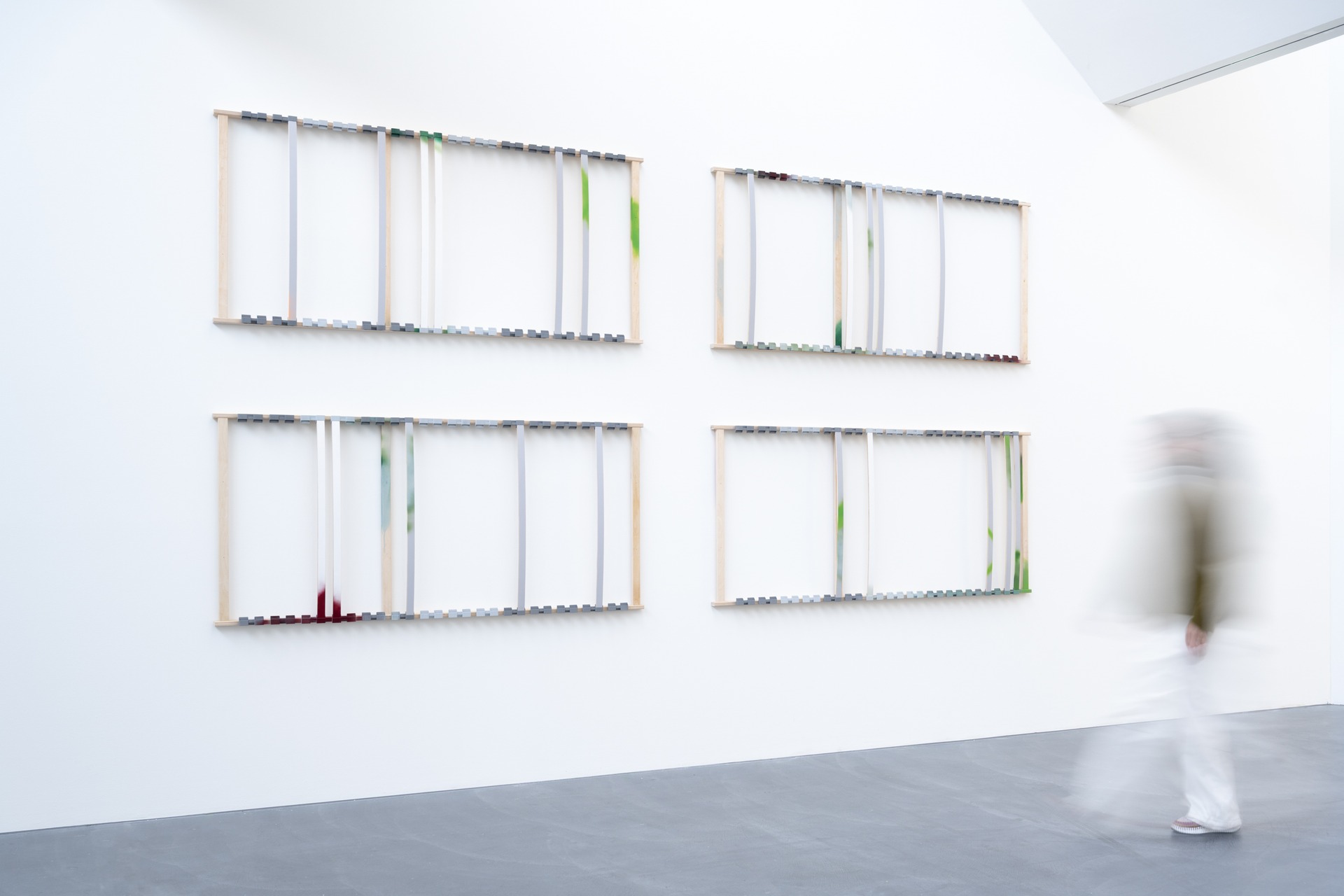
Four slatted frames hang sideways on the wall, in a two-by-two grid. Spray-painted accents here and there lend the impression of a painting, though there isn’t any linen ground.
LR_06, 2026 is the most recent work in the series of slatted frames within the exhibition Grammatik einfach erklärt (Grammar Simply Explained) by Florian Slotawa. The exhibition runs until March 7, 2026. The title alludes to the formal system Wassily Kandinsky outlined 100 years ago in the Bauhaus book Punkt und Linie zu Fläche (Point and Line to Plane, 1926). In his art-theory treatise, point, line, and plane make up the basic compositional elements of a visual language—a grammar of abstract art.
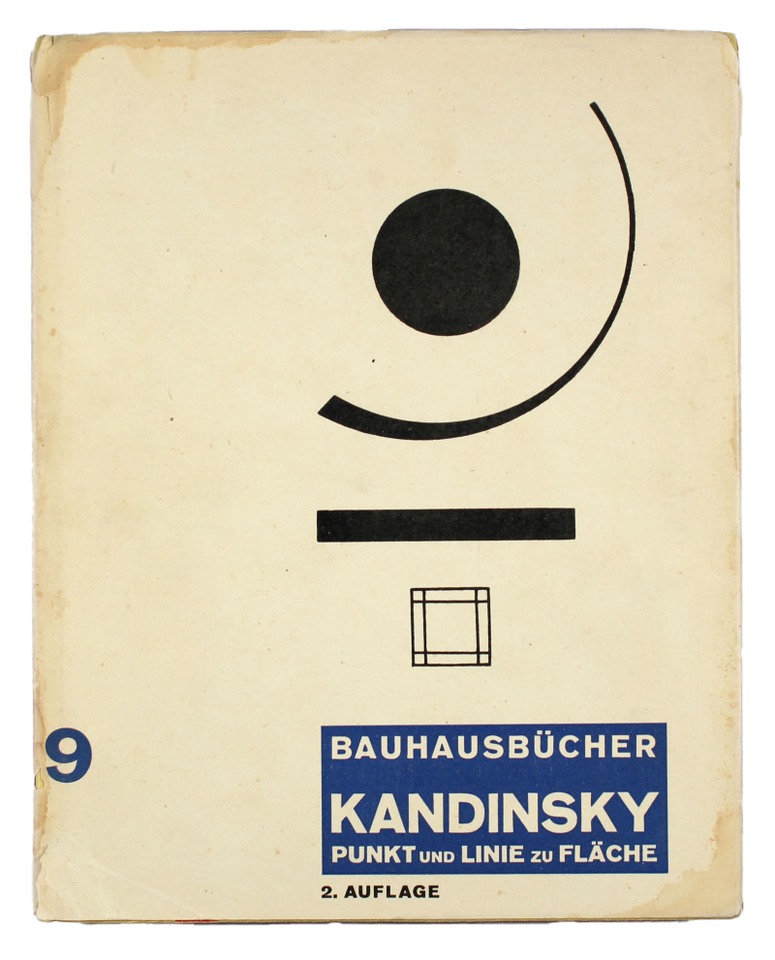
Book cover of Wassily Kandinsky’s
"Punkt und Linie zu Fläche" (Point and Line to Plane), 1926
Composite arrangement of scans showing basic abstract elements from Wassily Kandinsky’s "Punkt und Linie zu Fläche" (Point and Line to Plane), 1926
Seen from a distance, the rubber part that holds the slats becomes a point, the slats form a line, and the frame defines the plane. In their usual environment, the wooden structures would have served as mattress supports. Now, only a few of the 28 slats remain, which are white or gray depending on their role in supporting healthy sleep. The rest are missing in various places, exposing the gallery wall behind.
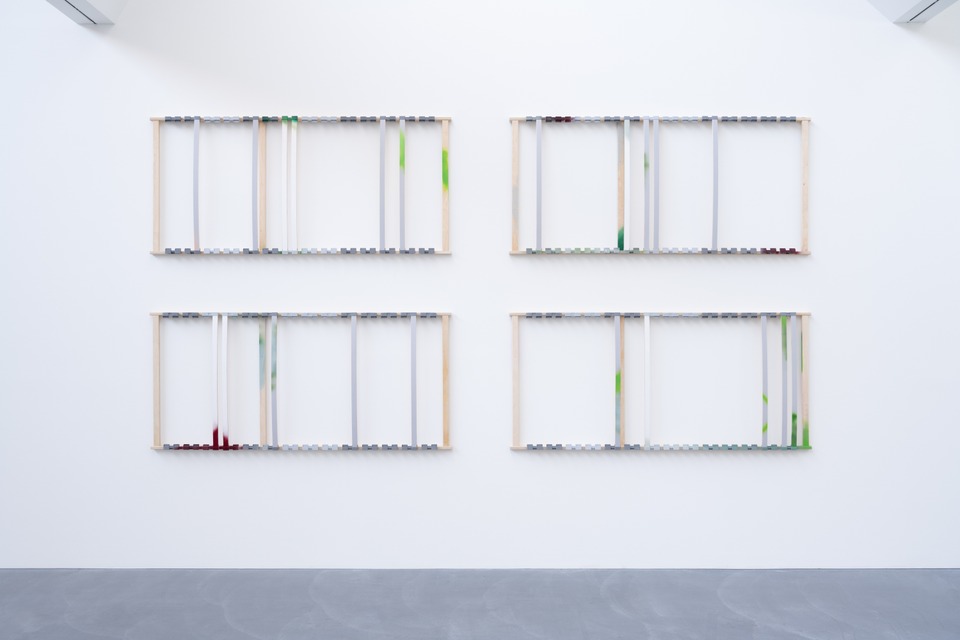
Florian Slotawa, exhibition view, "Grammatik einfach erklärt," view on "LR_06," 2026, von Bartha, Basel, 2026. Photo by Finn Curry
However, the comparison between Slotawa and Kandinsky is limited. Slotawa goes far beyond Kandinsky in using just a few interventions to declare the four slatted frames as paintings, without actually painting them. The form already exists, as do the colors in the can. Mixtures result from layering the prefabricated paints. No brush touched the surface, not even once. Instead of imagination and spirituality, conceptual rigor prevails. The underlying principle is simple:
Take existing things.
Sort identical objects, combine them with other elements, or remove parts so that they have distinctive features.
Arrange them in the exhibition space, individually or in groups.¹
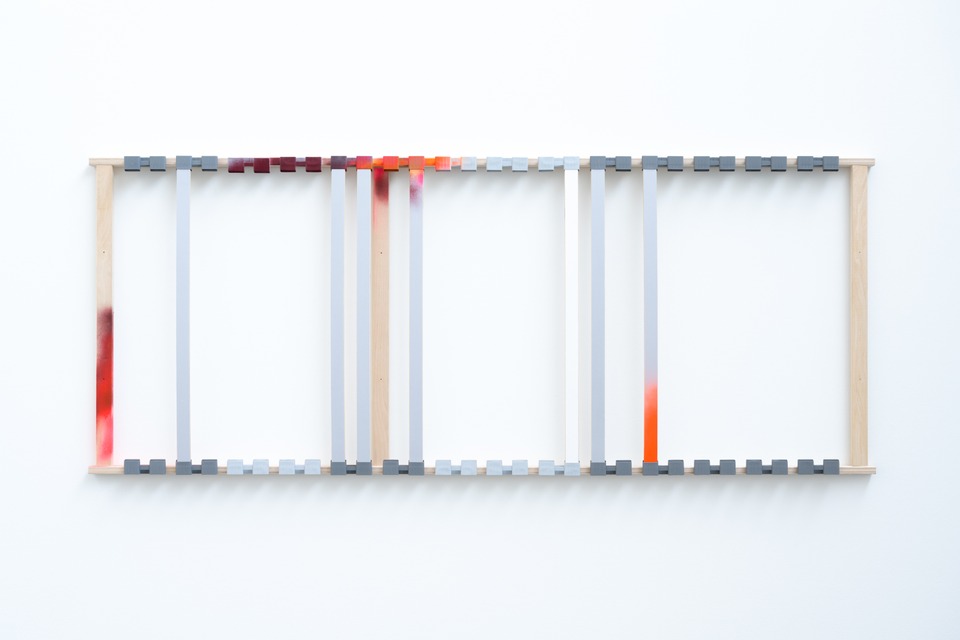
Florian Slotawa, view on "LR_03," 2025, von Bartha, Basel, 2026. Photo by Finn Curry
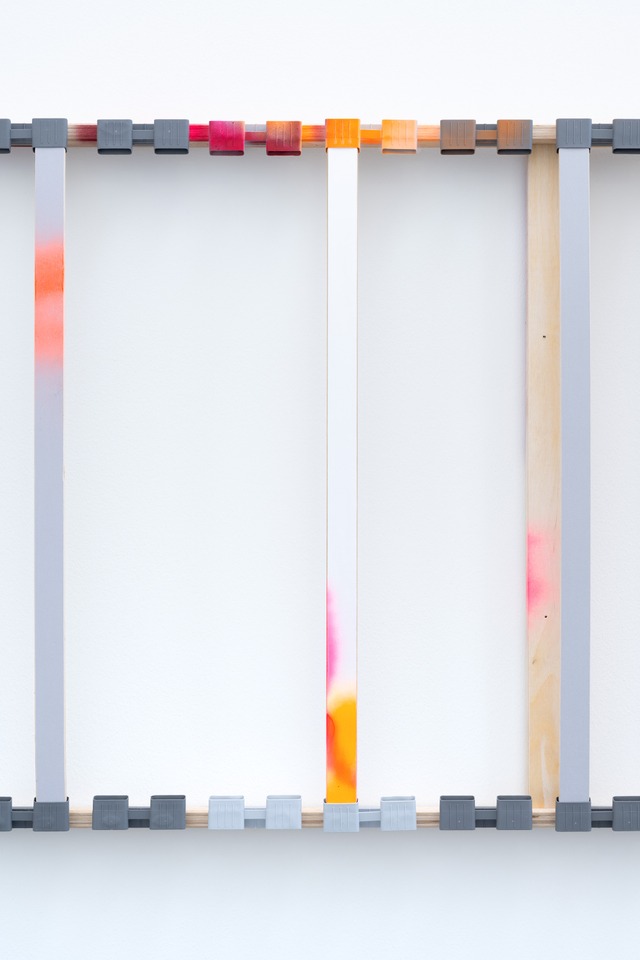
Florian Slotawa, view on "TB_01," 2023, von Bartha, Basel, 2026. Photo by Finn Curry
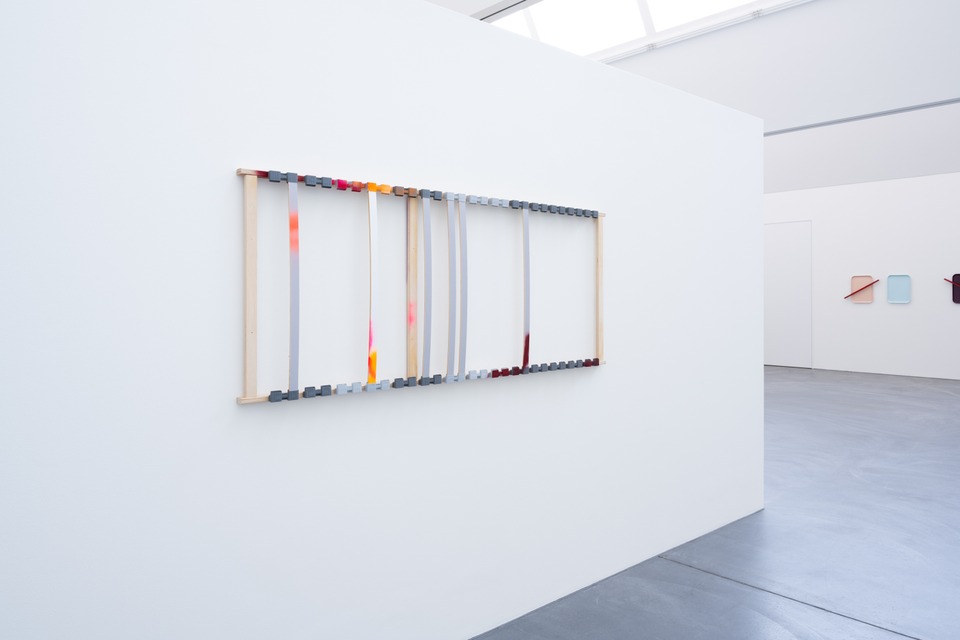
Florian Slotawa, exhibition view, "Grammatik einfach erklärt," view on "LR_04," 2025, von Bartha, Basel, 2026. Photo by Finn Curry
In the 1990s, Slotawa used his own possessions, later those of his gallerists, museum inventory, or art by other artists. The works KS.068 and KS.069 from the series kleine Skulpturen (small sculptures) were exhibited two years ago at the Staatsgalerie Stuttgart alongside drawings and a wooden figure by Ernst Ludwig Kirchner from the collection. KS.068 consists of a hollow neon-pink cube on a pedestal-like scaffold, and in Stuttgart the work responded to the museum’s presentation of Kirchner’s Kleiner Adam, 1911. The carved wooden figure stood on a white pedestal, enclosed and protected by a climate display case. Slotawa’s intervention started from the observation that Eve was missing from Kirchner’s work, and he presented his pre-existing sculpture next to Adam as an accompaniment. Taken on its own, the work remains a reflection on the institutional frameworks and supports that stage art’s supposedly sublime status.²
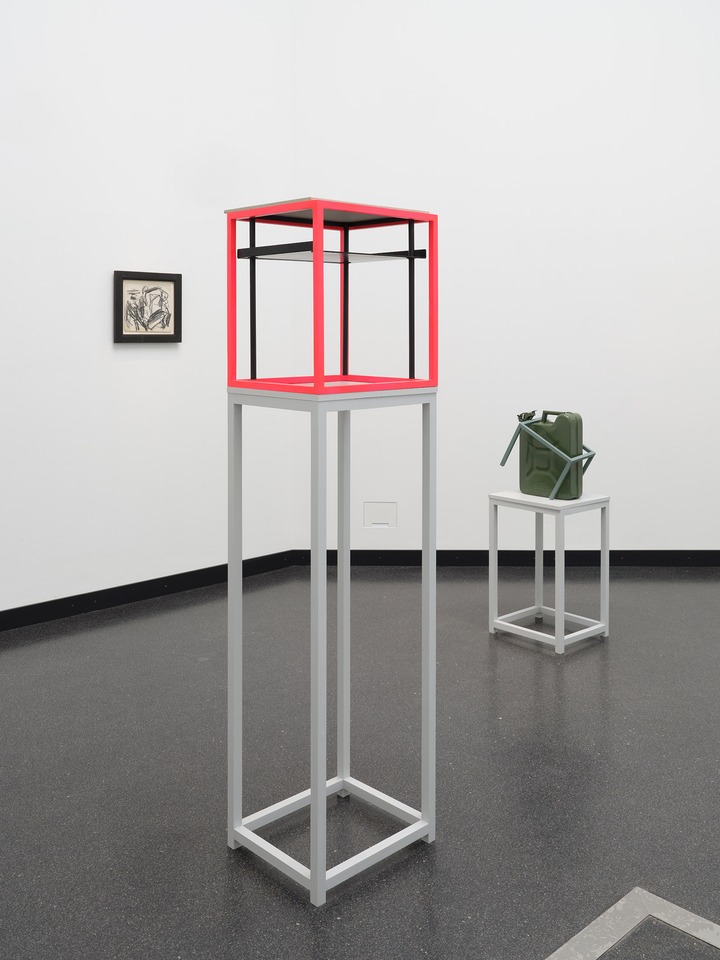
View on Florian Slotawa’s "KS.068" and "KS.069" at the exhibition "Florian Slotawa. Stuttgart sichten" at Staatsgalerie Stuttgart. Both photos by Staatsgalerie Stuttgart
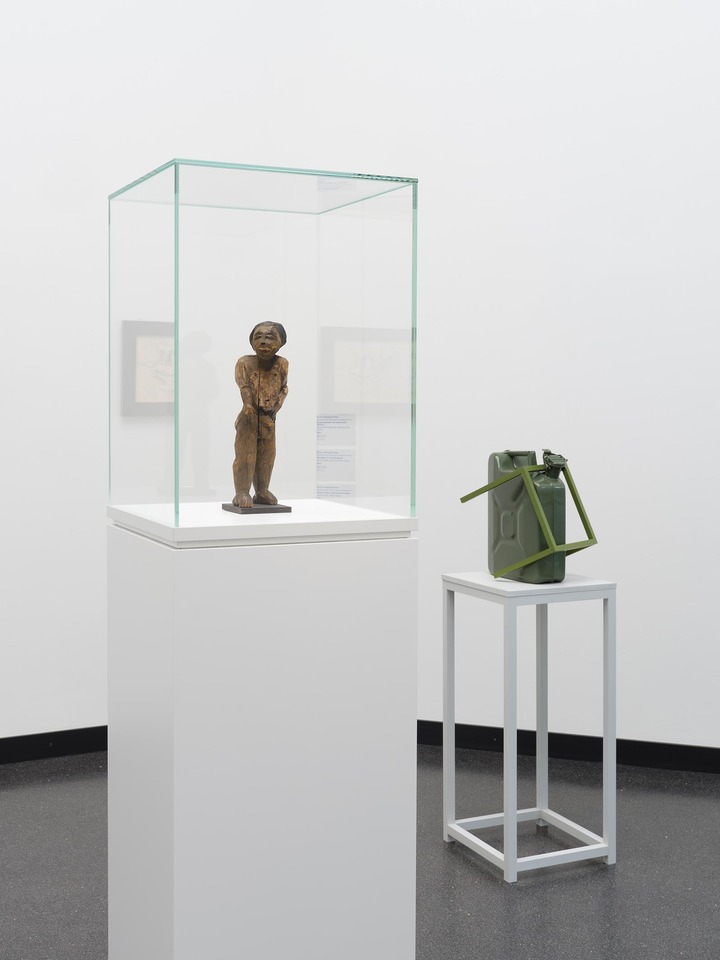
View on Florian Slotawa’s "KS.069" next to
Ernst Ludwig Kirchner’s "Kleiner Adam," 1911
The three canisters from the work KS.069 were also shown alongside Kirchner’s works. The military-green containers from the hardware store, each with a capacity of 10 liters, were elevated into sculptures by filigree pedestals. Each canister features an additional abstract form in differing shades of green, introducing a painterly moment into the space. At the Stuttgart exhibition, these elements corresponded to the faded color of Kirchner’s figure. Having arrived at Galerie von Bartha and in the present, the gasoline tanks no longer require a pedestal.
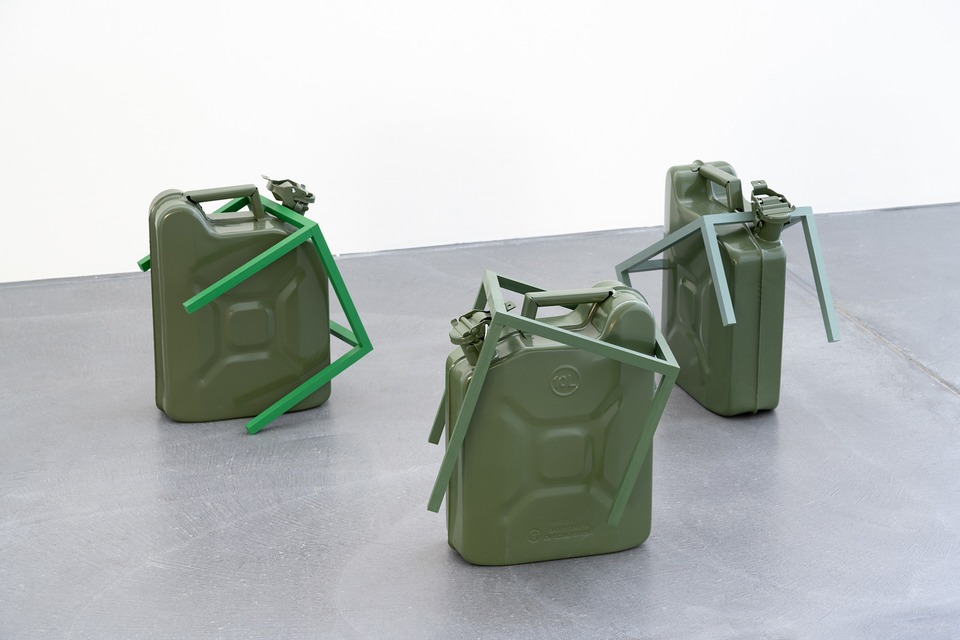
Florian Slotawa, view on "KS.069," 2025, von Bartha, Basel, 2026. Photo by Finn Curry
Slotawa works with objects that serve a specific purpose in everyday life. The canisters could be filled with fuel at the pumps in front of the gallery. Their formal and aesthetic qualities are secondary to their function. But this changes when they are transferred into the exhibition space, repurposed through subtle modifications, and combined with other components.
From a distance, it is hard to recognize that the series of differently colored trays in the work TB_2 could have once been used to serve food on the tables of a university cafeteria or retirement home. Now, the eight serving trays are hung in sets of two on the wall. A single red U-profile accompanies each pair. The varying placement of the linear aluminum elements follows a logic that creates a rhythmic dynamic. Only on closer inspection does one see the protruding details on the former trays, which can no longer hold any dishware. An anonymous designer was probably responsible for their shape and color, and machines for their production. No sculptor or painter in the classical sense was at work here—chiseling stone, casting metal, carving wood, or expressing themselves in painting with self-mixed pigments. Slotawa uses pre-existing mass products and reassembles them in a serial manner, according to a carefully thought-out set of rules.
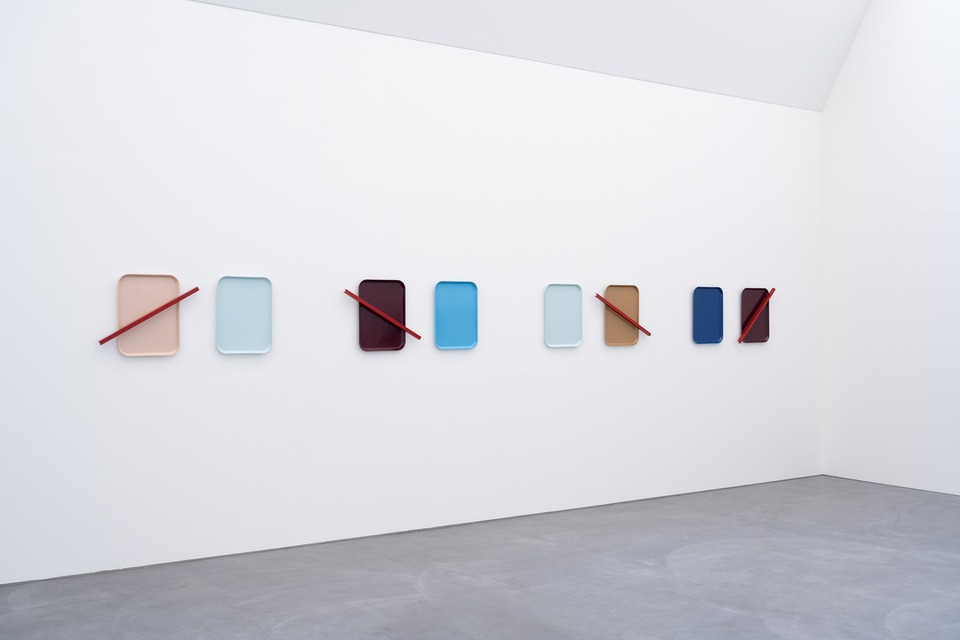
Florian Slotawa, exhibition view, "Grammatik einfach erklärt," view on "TB_02," 2025, von Bartha, Basel, 2026. Photo by Finn Curry
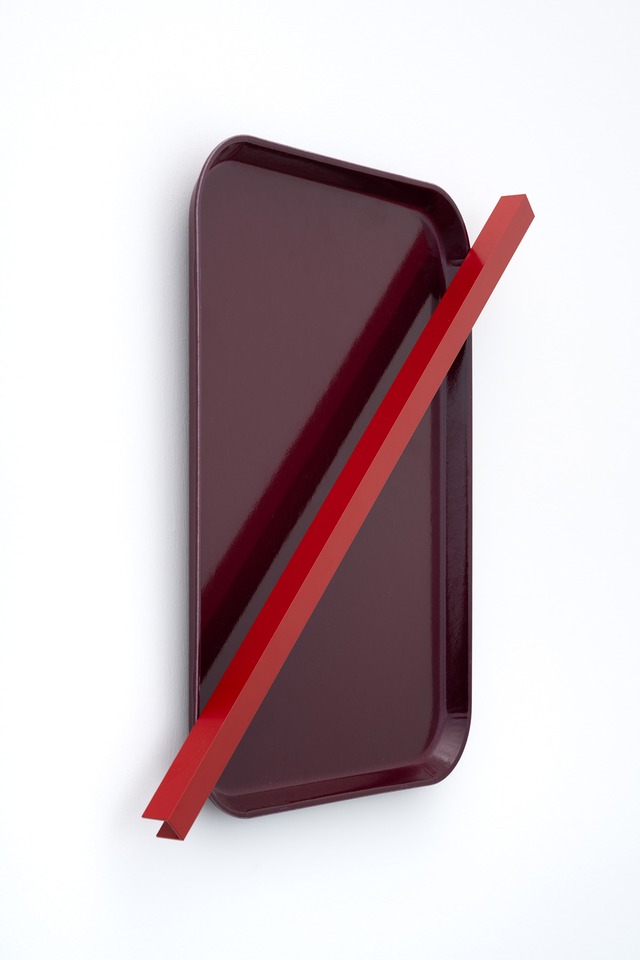
Florian Slotawa, detail view of "TB_02," 2025, von Bartha, Basel, 2026. Photo by Finn Curry
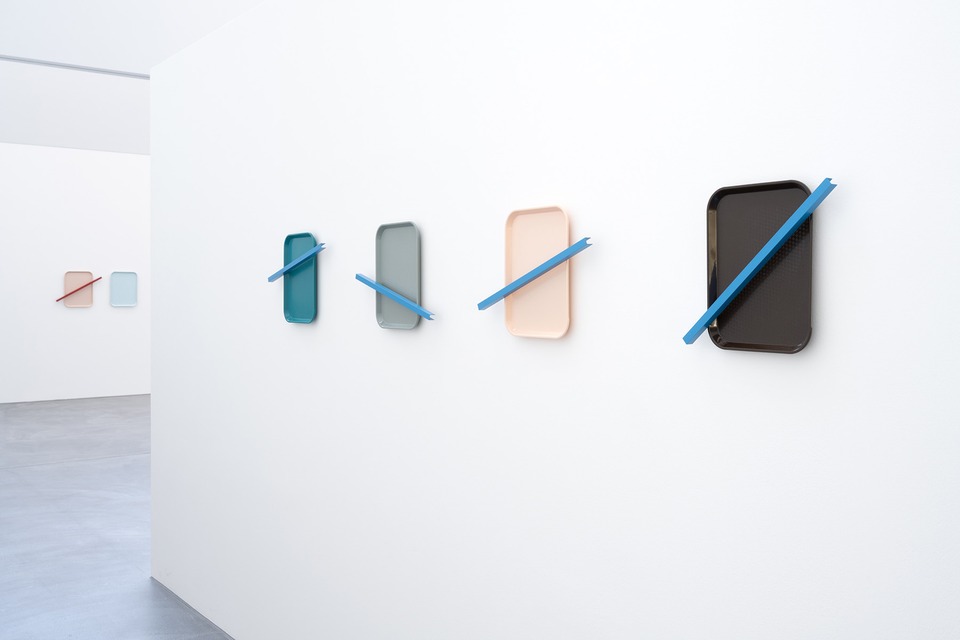
Florian Slotawa, exhibition view, "Grammatik einfach erklärt," view on "TB_01," 2023, von Bartha, Basel, 2026. Photo by Finn Curry
The formal norms of functional objects are the main frame of reference for his work: the sizes of the canisters, trays, and slatted frames, prefabricated colors and profiles. Their standardized parameters are measurable and reproducible. Unlike mass-produced goods, art still retains some claim to uniqueness to this day. The breach of rules—which isn’t really a transgression anymore—takes place in the assertion that slatted frames and serving trays are paintings and canisters are sculptures. Mounting them on the wall or suggesting a pedestal is enough. There’s also a humorous moment to this, introduced by the ambiguity. Grammar is ultimately anything but simple when you take it seriously.
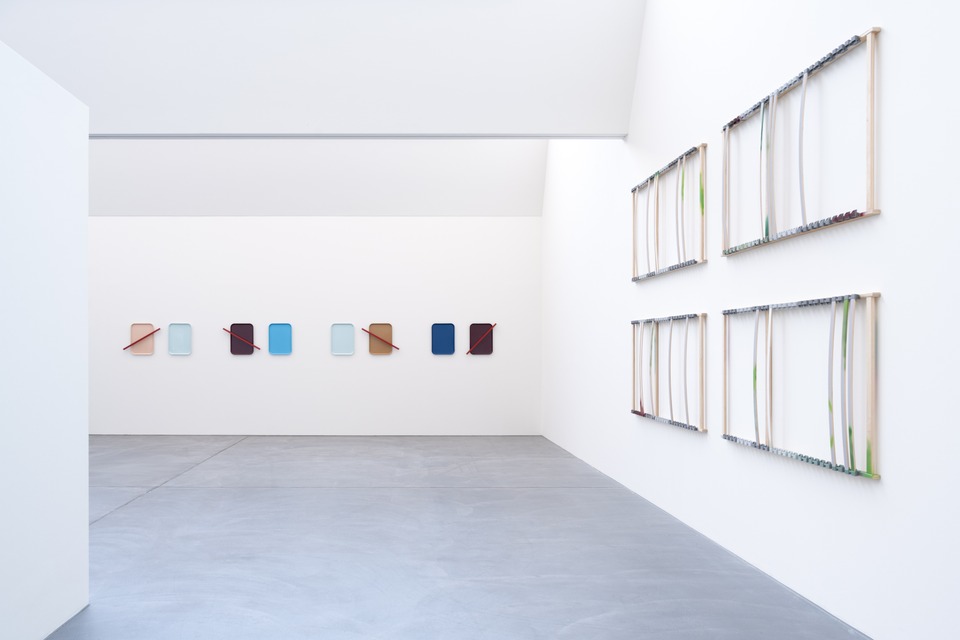
Florian Slotawa, exhibition view, "Grammatik einfach erklärt," view on "TB_02," 2025, and "LR_06," 2026, von Bartha, Basel, 2026. Photo by Finn Curry
When Slotawa transfers functional objects into the exhibition space and arranges them into new formal-aesthetic compositions, he combines two ways of making art that were still perceived as incompatible in the 1970s: formalism and conceptual art. On the one hand, Slotawa’s series break with the expectations placed on art and, through his method, invite critical questioning of these assumptions. On the other hand, the emphasis on form, color, line, and structure in his work also suggests a universal language that manifests not only in abstract art but also in everyday life.
About the author: Lara Holenweger is a Zurich-based art historian. With a background in art she critically engages with contemporary practices and their histories, particularly conceptual and performative ones.
This text was translated from German into English.
1 This is the author’s own assessment. Slotawa himself does not actually work with instructions or scores, as was common in conceptual art of the 1960s and 1970s. However, his practice can be understood in this way.
2 Like many Expressionists, Kirchner was driven by an aesthetic appreciation of what was then categorized as “African art” and reproduced a racist stereotype: Adam appears as a Black figure with an erect phallus, evoking colonial fantasies of hypersexualized Black masculinity. Positioned next to Kirchner's work, Slotawa's non-representational sculpture draws attention to institutional displays that perpetuate such colonial and racist narratives.